
Bored Hoard
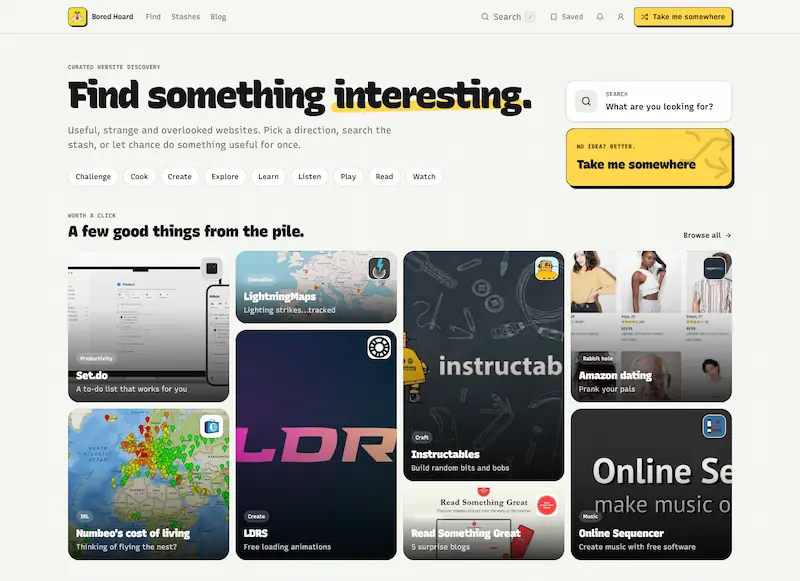
Bored Hoard is a discovery-first platform for websites worth finding: curated Stashes, search, Smart Random, richer site profiles, voting, saving and a deliberately opinionated catalogue.

Bored Hoard started during lockdown, when the official hobbies were apparently making bread, learning a language and slowly losing the ability to recognise what day it was.
I already knew how to make bread and I already spoke three languages, so I needed a different way to survive the boredom without becoming one of those people who suddenly has very strong opinions about sourdough hydration.
The idea was simple: build a place full of websites that could make the internet feel interesting again.
Not the obvious stuff. Bored Hoard was for the smaller gold flakes still floating around: useful tools, weird corners, creative projects, games, references, experiments and occasionally things so useless they loop back around into being useful.
We get rid of the crap and leave the shiny bits.
That part never changed.
What did change was almost everything underneath it.
The rebuild
The original Bored Hoard grew into a WordPress directory with categories, submissions, favourites and a weekly discovery format.
By 2026, keeping the old structure alive was starting to make less sense than asking what the project should actually be now.
So I rebuilt it.
Version 2 moves away from being a directory that happens to contain interesting websites and towards a product designed around discovery itself.
The core loop is now simple: find something, open it, save or vote if it is worth remembering, then keep going.
The old weekly boxes became Stashes: curated groups of sites that can exist because they belong together, not because a publishing calendar says it is Tuesday.
Random browsing became Smart Random, designed to preserve surprise without repeatedly throwing back things you have already seen, saved or voted on.
Accounts also had to earn their existence. Browsing and voting still work without one. Signing in gives you persistence: Saved sites, vote history, recent discoveries, submissions and updates.
What it does now
Bored Hoard v2 currently includes:
- a curated catalogue of more than 1,100 websites;
- search, categories, tags and pricing filters;
- editorial Stashes;
- Random and “Next cool site” discovery;
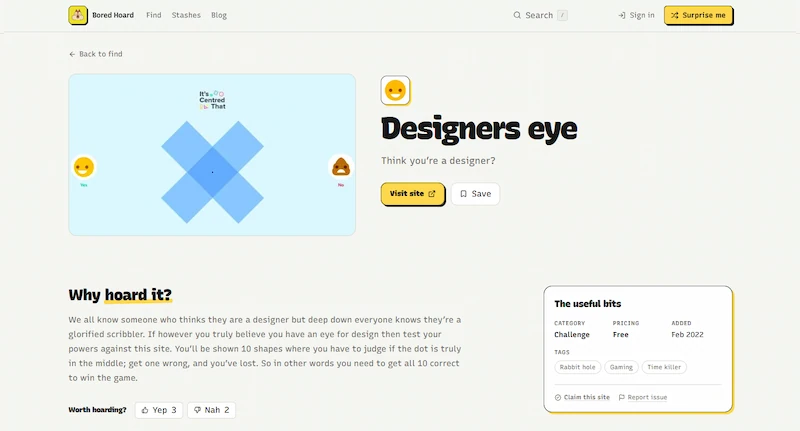
- richer individual site profiles;
- anonymous and account voting;
- saved sites and member history;
- website submissions and reporting;
- ownership verification and factual update requests;
- Rabbit holes, the editorial side of the project;
- a moderation and admin system behind the public product.
The catalogue is deliberately not exhaustive. More websites is not automatically better discovery.
The decisions underneath it
The interesting part of this rebuild was not replacing WordPress with newer technology.
It was deciding what the product should and should not optimise for.
A discovery site can very easily turn into another feed trying to keep people inside it. Bored Hoard works almost the other way around: success can mean finding something good and leaving the site to explore it.
Owners can keep factual information accurate, but they do not control Bored Hoard’s editorial judgement.
Users can vote before creating an account, because authentication should buy something rather than act as an entrance fee.
And the migration was treated as curation rather than copying. Dead and unreachable websites were deliberately left behind instead of being preserved just to make the numbers reconcile.
That last decision sounds small until a migration produces a large mismatch and the tempting fix is to undo a correct decision simply because the totals look untidy.
Rebuilding the old thing without preserving all of it
The rebuild also meant moving years of useful history out of the old WordPress/VPS setup.
The final live catalogue contains 1,162 published sites. Thousands of legacy bookmarks and vote signals were reconciled and restored where the underlying sites still belonged in the product.
Some did not.
That was one of the more useful lessons from the project: migration is not always preservation. Sometimes the important work is deciding what deserves to survive.
Current state
Bored Hoard v2 went live on 29 October 2026.
The public product, accounts, submissions, ownership flows and admin operations are live. The current phase is deliberately less exciting: watch what people actually use, fix what breaks and resist inventing the next five features before there is evidence for them.
There are plenty of possible directions later - personalised discovery, user-created Stashes, browser extensions, richer owner tools - but they are possibilities, not promises.
For now, Bored Hoard is back where it should be:
a place for finding parts of the web that are still worth getting lost in.